More and more rules assume that a website knows where its visitor is. Tax, licensing, age checks and sanctions all lean on one lookup: the place an IP address is listed in. This autumn a court and two research groups looked at how far that lookup can be trusted.
The ruling
On 24 September 2026 a federal court in Utah put on hold one provision of the state’s age-verification law. The provision counted a visitor as being in Utah whenever they were actually there, even if a VPN made them appear to be somewhere else. The reasoning was technical: read as written, the law demanded something that cannot be done.
The opinion calls it undisputed that “geolocation perfection is not presently possible”, and notes that all the parties agreed location by IP address misses anyone whose connection hides where they are. The Electronic Frontier Foundation’s summary explains the case. The provision is blocked while the case continues.
What the research found
Two papers put numbers on it. The first, WHEREIS, accepted at this year’s Internet Measurement Conference, measured where blocks of addresses are really used and compared that with the part of the world they are registered in. At that coarse level, over 98% matched. The mismatches were real, though, and the authors found them in three commercial location databases as well.
The second looked at the measuring instruments themselves. By looking for replies that came back faster than a signal could have travelled, its authors concluded that at least 2% of the vantage points of RIPE Atlas, the largest community-run measurement network, were not where their operators said they were.
What a measurement can and cannot say
Put together, the picture is consistent. A listed location is right most of the time. It is wrong in a small share of cases that nobody can pick out by reading the list. And an address is never a person.
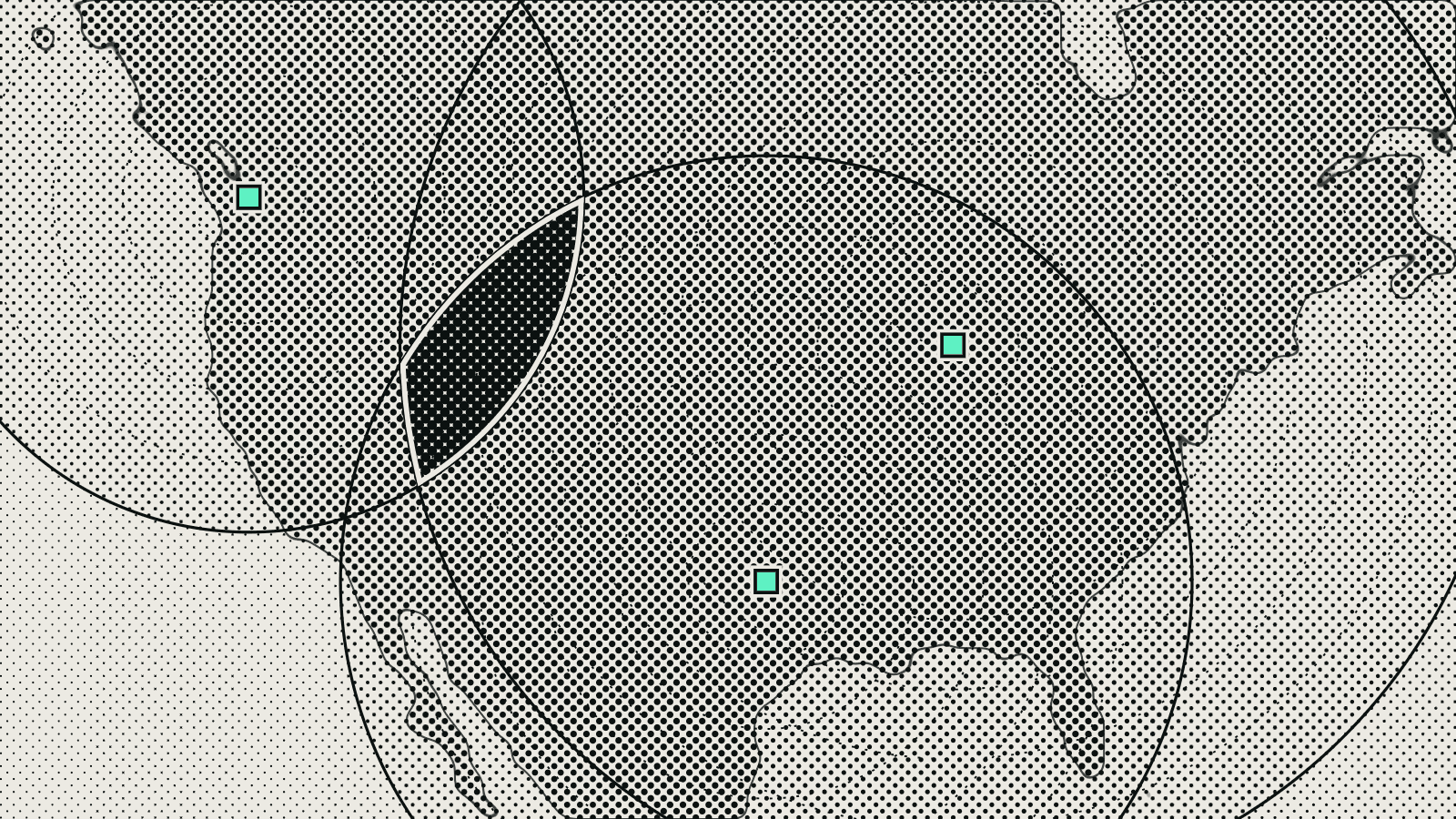
- It can test a claim. A reply cannot travel faster than light in fibre, so a quick answer puts a hard limit on how far away an address can be.
- It gives an area, not a point. How wide the area is depends on how close the nearest measuring node is.
- It finds the machine that answers. Behind a VPN that is the VPN’s exit, not the visitor.
- It is only as good as what is known about the nodes. A node in the wrong place on the map moves every answer that leans on it.
This is how we treat IP location at Hopbits. A lookup times replies from several nodes and returns an area, a confidence level and each node’s reply, with the database record shown beside it so you can see when the two disagree. It is a check on a database, not a replacement for one. The network is young and few nodes are close to any given address yet, so treat today’s answers as a coarse check, not a street address.
Sources
- Aylo Freesites v. Utah Division of Consumer Protection, memorandum decisionUS District Court, District of Utah · 24 September 2026
- Court Agrees with EFF: Utah’s VPN Law Demands a Technical ImpossibilityElectronic Frontier Foundation · 1 October 2026
- WHEREIS: IP Address Registration Geo-ConsistencyBeverly, Phokeer and Gasser · IMC 2026
- Rooting Out Incorrect RIPE Atlas Probe GeolocationsIzhikevich and others · revised July 2026